Developer Guide
- Acknowledgements
- Setting up, getting started
- Design
- Implementation
- Documentation, logging, testing, configuration, dev-ops
- Appendix: Requirements
-
Appendix: Instructions for manual testing
- Launch and shutdown
- Data Storage
- Deleting a person
- Adding a person
- Editing a person
- Purging all contacts
- Deleting multiple contacts with clear
- Untagging contacts
- Handling payments
- Finding a contact
- Sorting contacts
- Filtering contacts
- Listing all contacts
- Displaying help
- Toggling application theme
- Exiting the application
Acknowledgements
- This project is based on the AddressBook-Level3 project created by the SE-EDU initiative.
-
ColorUtil:isLightColoris slightly adopted from the StackOverflow discussions here.
Setting up, getting started
Refer to the guide Setting up and getting started.
Design
 Tip: The
 .puml files used to create diagrams in this document docs/diagrams folder. Refer to the PlantUML Tutorial at se-edu/guides to learn how to create and edit diagrams.
Architecture
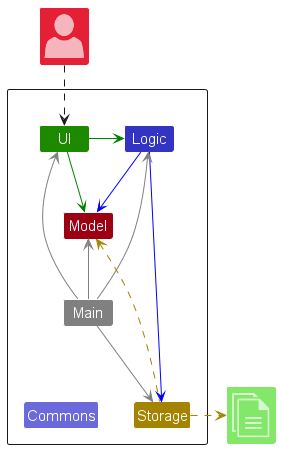
The Architecture Diagram given above explains the high-level design of the App.
Given below is a quick overview of main components and how they interact with each other.
Main components of the architecture
Main (consisting of classes Main and MainApp) is in charge of the app launch and shut down.
- At app launch, it initializes the other components in the correct sequence, and connects them up with each other.
- At shut down, it shuts down the other components and invokes cleanup methods where necessary.
The bulk of the app’s work is done by the following four components:
-
UI: The UI of the App. -
Logic: The command executor. -
Model: Holds the data of the App in memory. -
Storage: Reads data from, and writes data to, the hard disk.
Commons represents a collection of classes used by multiple other components.
How the architecture components interact with each other
The Sequence Diagram below shows how the components interact with each other for the scenario where the user issues the command delete 1.
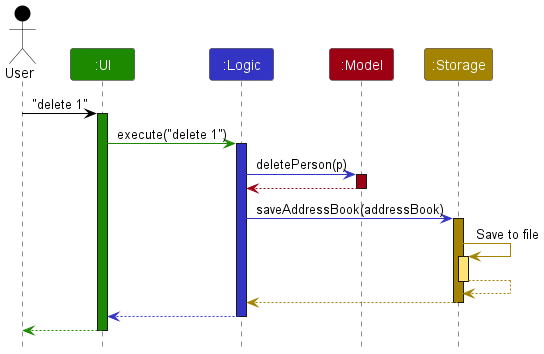
Each of the four main components (also shown in the diagram above),
- defines its API in an
interfacewith the same name as the Component. - implements its functionality using a concrete
{Component Name}Managerclass (which follows the corresponding APIinterfacementioned in the previous point.
For example, the Logic component defines its API in the Logic.java interface and implements its functionality using the LogicManager.java class which follows the Logic interface. Other components interact with a given component through its interface rather than the concrete class (reason: to prevent outside component’s being coupled to the implementation of a component), as illustrated in the (partial) class diagram below.
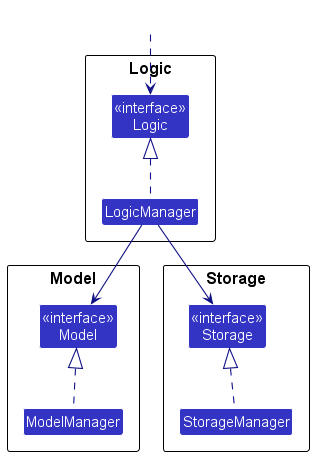
The sections below give more details of each component.
UI component
The API of this component is specified in Ui.java
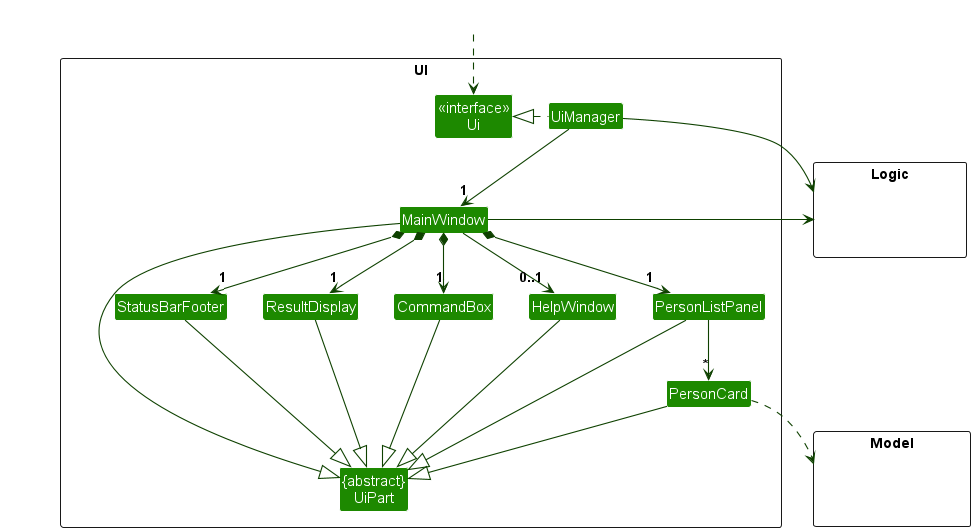
The UI consists of a MainWindow that is made up of parts e.g.CommandBox, ResultDisplay, PersonListPanel, StatusBarFooter etc. All these, including the MainWindow, inherit from the abstract UiPart class which captures the commonalities between classes that represent parts of the visible GUI.
The UI component uses the JavaFx UI framework. The layout of these UI parts are defined in matching .fxml files that are in the src/main/resources/view folder. For example, the layout of the MainWindow is specified in MainWindow.fxml
The UI component,
- executes user commands using the
Logiccomponent. - listens for changes to
Modeldata so that the UI can be updated with the modified data. - keeps a reference to the
Logiccomponent, because theUIrelies on theLogicto execute commands. - depends on some classes in the
Modelcomponent, as it displaysPersonobject residing in theModel.
Logic component
API : Logic.java
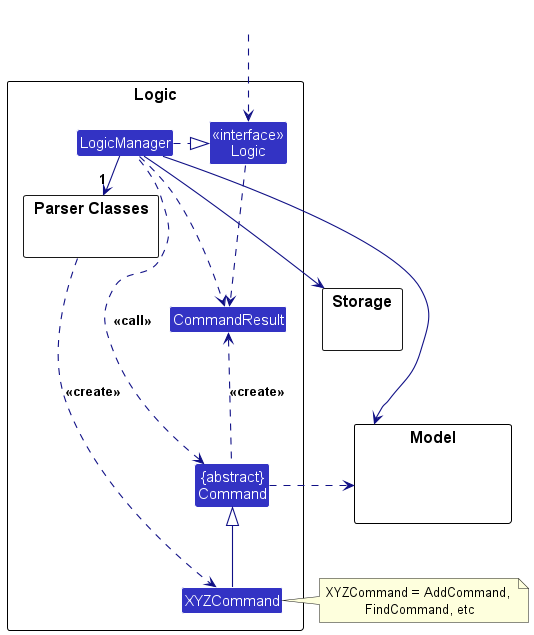
Here’s a (partial) class diagram of the Logic component:
The sequence diagram below illustrates the interactions within the Logic component, taking execute("delete 1") API call as an example.
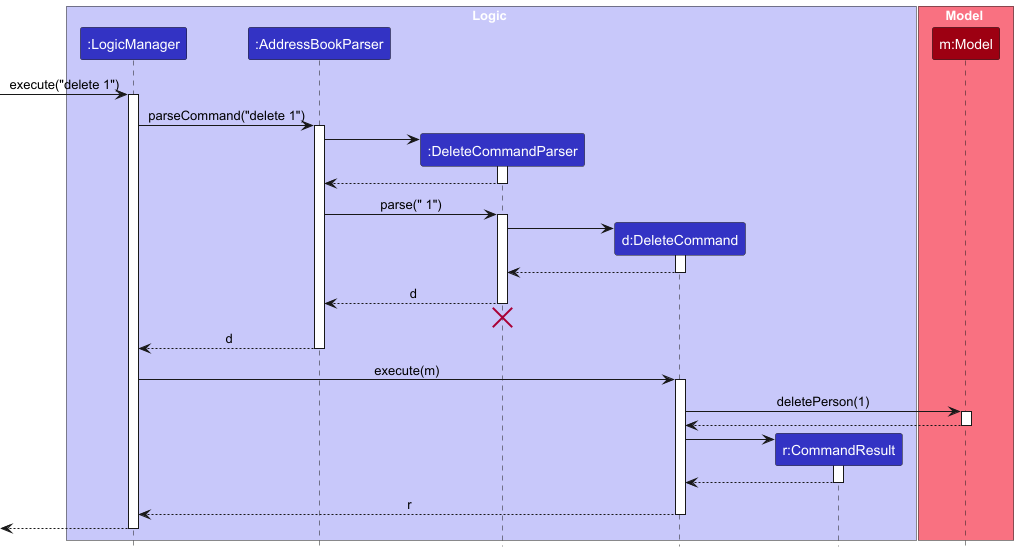
 Note: The lifeline for
 DeleteCommandParser should end at the destroy marker (X) but due to a limitation of PlantUML, the lifeline continues till the end of diagram.
How the Logic component works:
- When
Logicis called upon to execute a command, it is passed to anAddressBookParserobject which in turn creates a parser that matches the command (e.g.,DeleteCommandParser) and uses it to parse the command. - This results in a
Commandobject (more precisely, an object of one of its subclasses e.g.,DeleteCommand) which is executed by theLogicManager. - The command can communicate with the
Modelwhen it is executed (e.g. to delete a person).
Note that although this is shown as a single step in the diagram above (for simplicity), in the code it can take several interactions (between the command object and theModel) to achieve. - The result of the command execution is encapsulated as a
CommandResultobject which is returned back fromLogic.
Here are the other classes in Logic (omitted from the class diagram above) that are used for parsing a user command:
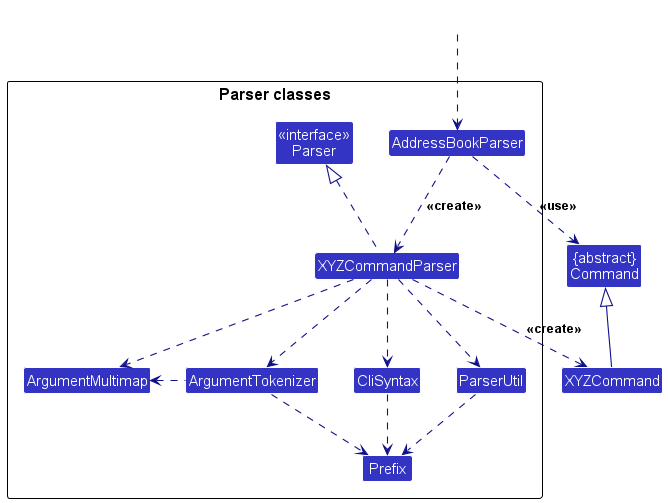
How the parsing works:
- When called upon to parse a user command, the
AddressBookParserclass creates anXYZCommandParser(XYZis a placeholder for the specific command name e.g.,AddCommandParser) which uses the other classes shown above to parse the user command and create aXYZCommandobject (e.g.,AddCommand) which theAddressBookParserreturns back as aCommandobject. - All
XYZCommandParserclasses (e.g.,AddCommandParser,DeleteCommandParser, …) inherit from theParserinterface so that they can be treated similarly where possible e.g, during testing.
Model component
API : Model.java
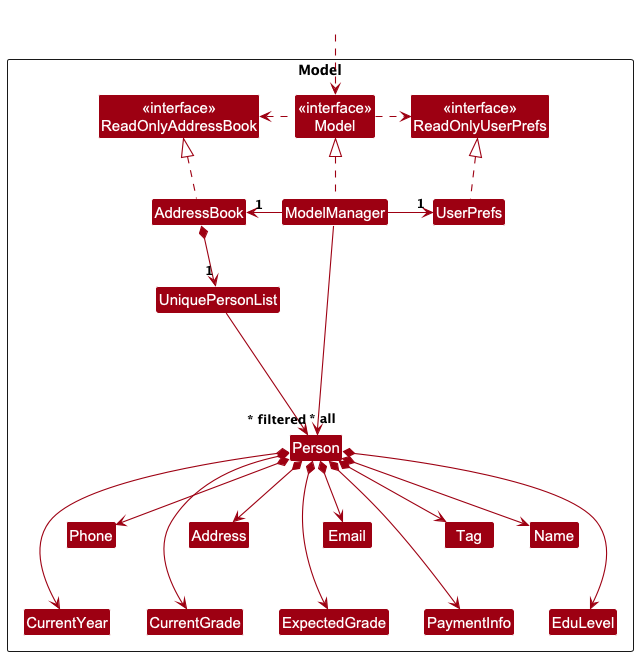
The Model component,
- stores the address book data i.e., all
Personobjects (which are contained in aUniquePersonListobject). - stores the currently ‘selected’
Personobjects (e.g., results of a search query) as a separate filtered list which is exposed to outsiders as an unmodifiableObservableList<Person>that can be ‘observed’ e.g. the UI can be bound to this list so that the UI automatically updates when the data in the list change. - stores a
UserPrefobject that represents the user’s preferences. This is exposed to the outside as aReadOnlyUserPrefobjects. - does not depend on any of the other three components (as the
Modelrepresents data entities of the domain, they should make sense on their own without depending on other components)
Potential Improvement: An alternative (arguably, a more OOP) model is given below. It has a Tag list in the AddressBook, which Person references. This allows AddressBook to only require one Tag object per unique tag, instead of each Person needing their own Tag objects.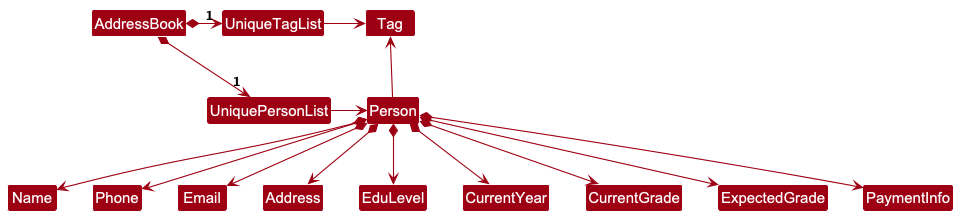
Storage component
API : Storage.java
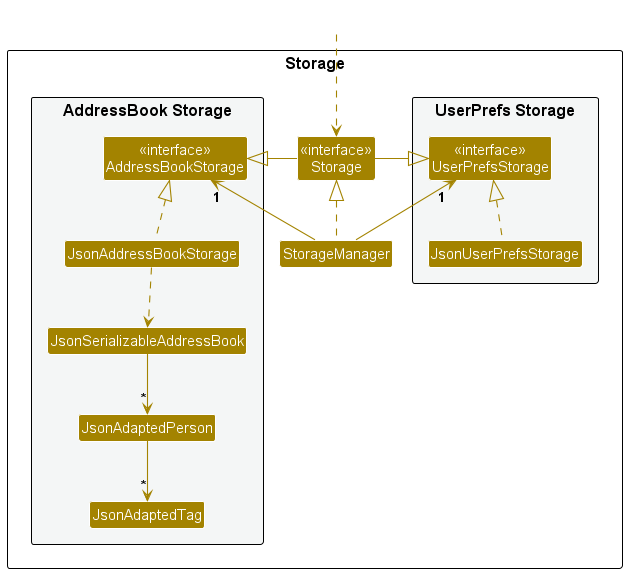
The Storage component,
- can save both address book data and user preference data in JSON format, and read them back into corresponding objects.
- inherits from both
AddressBookStorageandUserPrefStorage, which means it can be treated as either one (if only the functionality of only one is needed). - depends on some classes in the
Modelcomponent (because theStoragecomponent’s job is to save/retrieve objects that belong to theModel)
Common classes
Classes used by multiple components are in the seedu.address.commons package.
Implementation
This section describes some noteworthy details on how certain features are implemented.
Payment command feature
The following diagram shows the interaction flow for the command — payment 1 f/1000. This updates the payment information for a person at the given index with the specified fee.
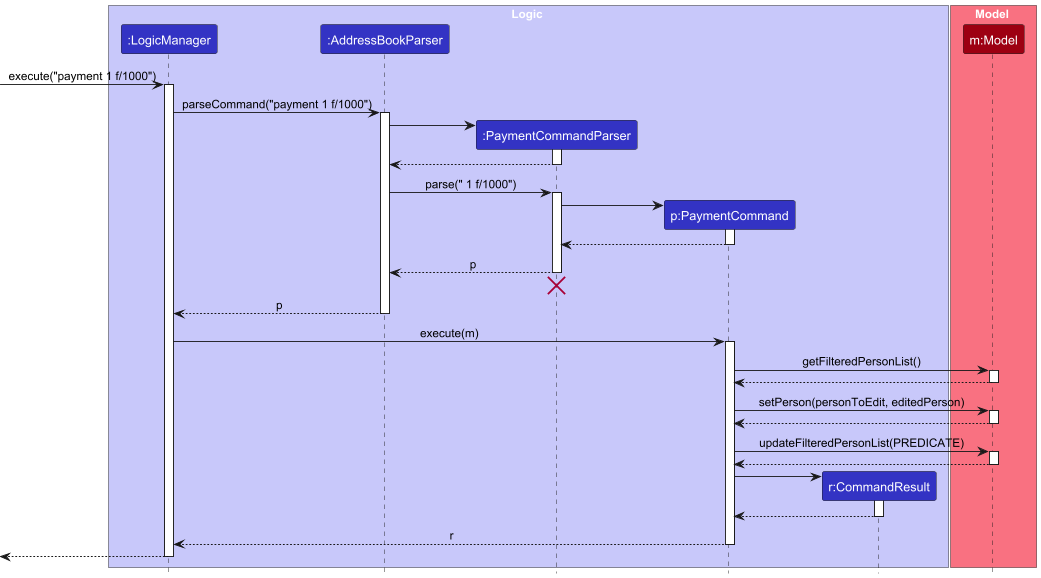
Note: The lifeline for PaymentCommandParser should end at the destroy marker (X) but due to a limitation of PlantUML, the lifeline continues till the end of diagram.
Sort Command Feature
The following diagram shows the interaction flow for the command — sort. This sorts the names in the list alphabetically.
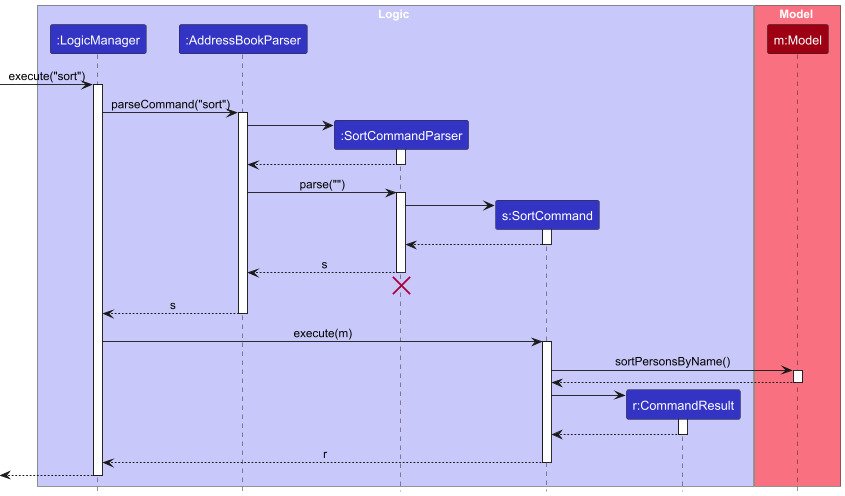
Note: The lifeline for SortCommandParser should end at the destroy marker (X) but due to a limitation of PlantUML, the lifeline continues till the end of diagram.
Untag Command Feature
The following diagram shows the interaction flow for the command — untag t/CS2040 t/Math. This removes the tag CS2040 and Math from all student records.
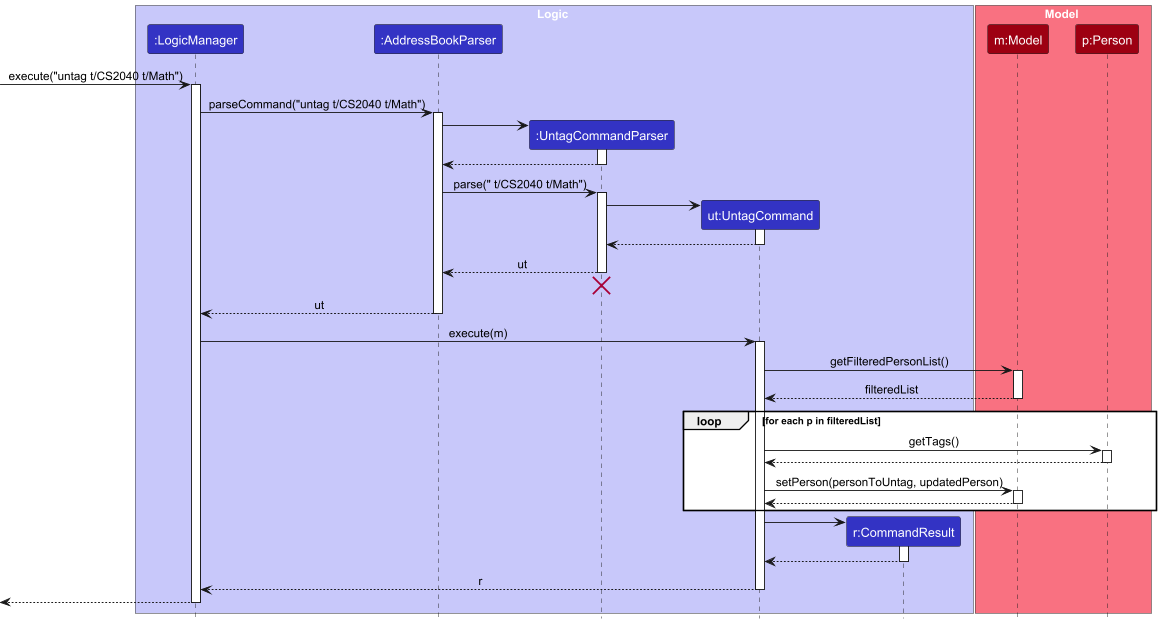
Note: The lifeline for UntagCommandParser should end at the destroy marker (X) but due to a limitation of PlantUML, the lifeline continues till the end of diagram.
Filter Command Feature
The following diagram shows the interaction flow for the command — filter cg/A. This filters the display list to show all persons with current grade A.
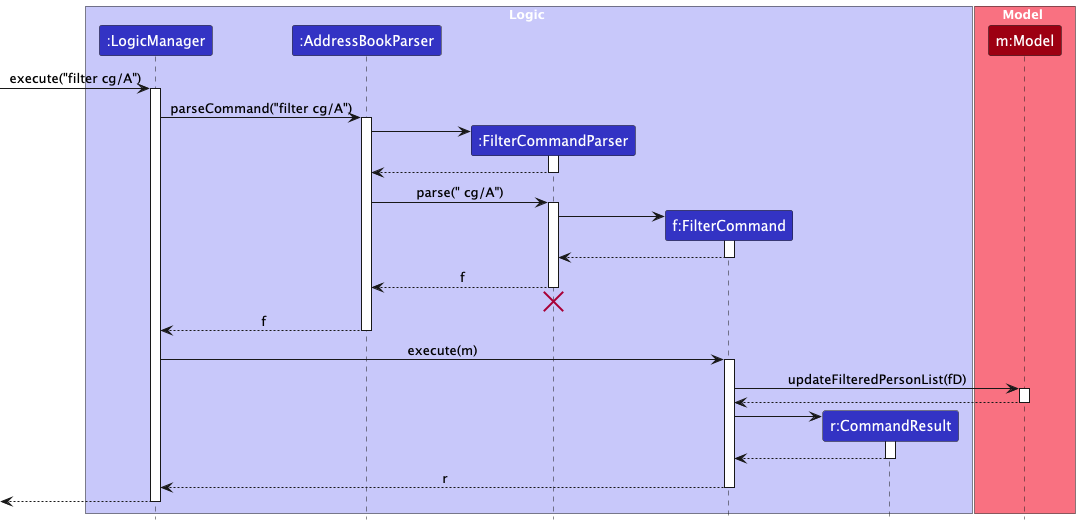
Note: The lifeline for FilterCommandParser should end at the destroy marker (X) but due to a limitation of PlantUML, the lifeline continues till the end of diagram.
Purge Command Feature
The following diagram shows the interaction flow for the command — purge. This purges the contact list of all student contacts.
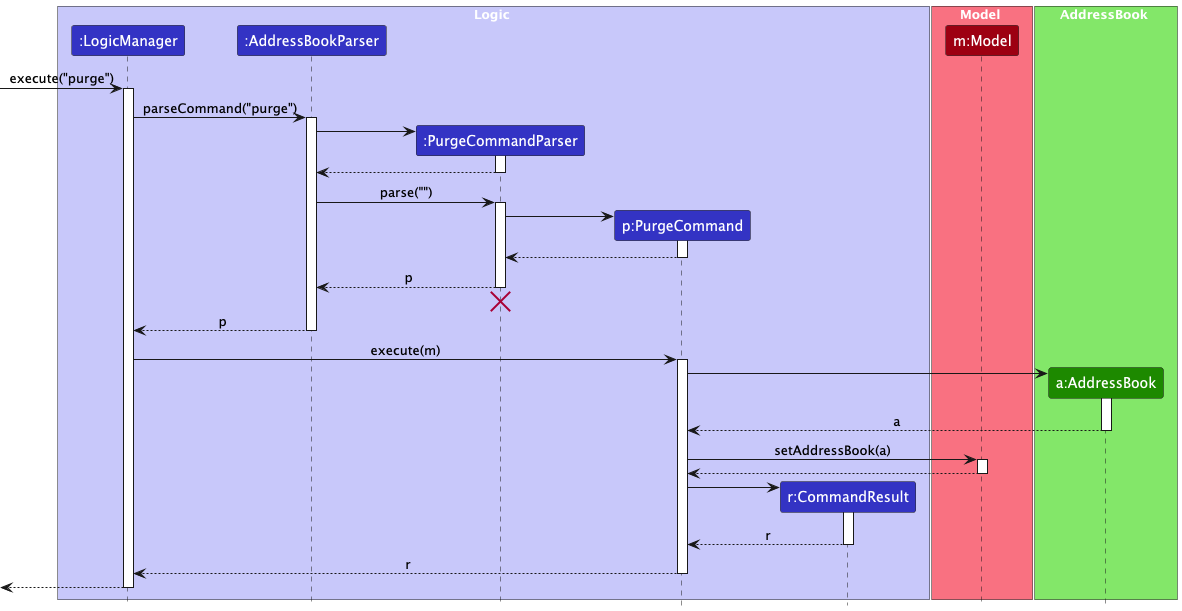
Note: The lifeline for purgeCommandParser should end at the destroy marker (X) but due to a limitation of PlantUML, the lifeline continues till the end of diagram.
Documentation, logging, testing, configuration, dev-ops
Appendix: Requirements
Product scope
Target user profile:
- has a need to manage a significant number of student contacts
- prefer desktop apps over other types
- can type fast
- prefers typing to mouse interactions
- is reasonably comfortable using CLI apps
- independent tutors and coaching professionals who are tech-savvy
Value proposition: Helps tutors organize student contacts and track their progress, reducing administrative work and improving learning outcomes
User stories
Priorities: High (must have) - * * *, Medium (nice to have) - * *, Low (unlikely to have) - *
| Priority | As a … | I want to … | So that I can… |
|---|---|---|---|
* * * |
Tutor (Beginner User) | Add student information | Have all necessary student info in one place. |
* * * |
Tutor (Beginner User) | Delete student information | Remove outdated or incorrect records. |
* * * |
Tutor (Beginner User) | List all student information | Look through an organized overview of all my students for easy reference and management. |
* * |
Tutor (Beginner User) | Search for student information by name | Quickly retrieve student records that match the name. |
* * |
Tutor (Beginner User) | Sort my student information when listing | Organize and view student records sorted based on a specific field. |
* |
Tutor (Beginner User) | Be able to change to Dark/Light mode | See certain assigned colors easier. |
* * |
Tutor (Intermediate User) | Edit student information | Update incorrect records. |
* * |
Tutor (Intermediate User) | Tag students into groups | Easily manage students by group type. |
* * * |
Tutor (Intermediate User) | Assign colors to groups | Visually differentiate student groups. |
* * * |
Tutor (Intermediate User) | Be able to efficiently add or remove tag from student | Efficiently manage a student’s tag without having to overwrite it instead. |
* * * |
Tutor (Intermediate User) | Be able to bulk remove ALL student information | Efficiently wipe out all student records onto a clean slate. |
* * |
Tutor (Intermediate User) | Be able to bulk remove certain tag from all students | Efficiently clear outdated tags. |
* * |
Tutor (Expert User) | Categorise student information | Better retrieve and organize relevant student data. |
* * |
Tutor (Expert User) | Perform bulk deletion of student information | Efficiently clear outdated records and prepare for a new semester. |
* * |
Tutor (Expert User) | Record student payments | Keep track of payments received. |
* * |
Tutor (Expert User) | Update payment statuses | Know which students have outstanding fees. |
* |
Tutor (Expert User) | Filter students by criteria | Quickly find relevant students. |
Use cases
Note: For all use cases below, the System is the TutorSynch and the Actor is the user (a tutor), unless specified otherwise.
Use case: UC01 - Add a new student
Guarantees:
- The new student record is saved if successfully added.
MSS
- User requests to add a new student with the necessary information.
- TutorSynch adds the student’s record.
-
TutorSynch shows the list of student records including the newly added.
Use case ends.
Extensions
- 1a. TutorSynch detects that user did not provide all mandatory details of a student.
- 1a1. TutorSynch shows an error message.
-
1a2. TutorSynch terminates the add process.
Use case ends.
- 1b. TutorSynch detects that user did not comply with required formatting for details of a student.
- 1b1. TutorSynch shows an error message.
-
1b2. TutorSynch terminates the add process.
Use case ends.
Use case: UC02 - Edit a student’s information
Preconditions:
- At least one student record exists in TutorSynch.
- User has identified the specific student to be edited.
Guarantees:
- The existing student record is updated if successfully edited.
MSS
- User requests to edit a specific student, alongside the new details.
- TutorSynch updates the relevant student record.
-
TutorSynch shows the list of student records including the newly updated.
Use case ends.
Extensions
- 1a. TutorSynch detects that user enters an invalid student reference.
- 1a1. TutorSynch shows an error message.
-
1a2. TutorSynch terminates the edit process.
Use case ends.
- 1b. TutorSynch detects that user did not comply with required formatting for details of a student.
- 1b1. TutorSynch shows an error message.
-
1b2. TutorSynch terminates the edit process.
Use case ends.
Use case: UC03 - Delete a student
Preconditions:
- At least one student record exists in TutorSynch.
- User has identified the specific student to be deleted.
Guarantees:
- The targeting student record is removed if successfully deleted.
MSS
- User requests to delete a specific student record.
- TutorSynch deletes the specified student record.
-
TutorSynch shows the updated list of student records.
Use case ends.
Extensions
-
1a. TutorSynch detects that user enters an invalid student reference.
- 1a1. TutorSynch shows an error message.
-
1a2. TutorSynch terminates the delete process.
Use case ends.
Use case: UC04 - List all students
MSS
- User requests to list all students records.
-
TutorSynch displays the full list of students with their information.
Use case ends.
Extensions
-
1a. Student list is empty.
-
1a1. TutorSynch informs the user of the empty list.
Use case ends.
-
Use case: UC05 - Record payment information for existing student
Preconditions:
- At least one student record exists in TutorSynch.
- User has identified the specific student to update their payment information.
Guarantees:
- The existing student record is updated with payment information if successfully recorded.
MSS
- User requests to record payment information for a specific student.
- TutorSynch adds the payment information to the student’s record.
-
TutorSynch shows the list of student records including the newly added payment information.
Use case ends.
Extensions
- 1a. TutorSynch detects that user enters an invalid student reference.
- 1a1. TutorSynch shows an error message.
-
1a2. TutorSynch terminates the edit process.
Use case ends.
- 1b. TutorSynch detects that user did not comply with required formatting for payment information of a student.
- 1b1. TutorSynch shows an error message.
-
1b2. TutorSynch terminates the edit process.
Use case ends.
Use case: UC06 - Bulk delete all student records
Preconditions:
- At least one student record exists in TutorSynch.
Guarantees:
- ALL existing student records will be removed.
MSS
- User requests to purge TutorSynch records.
- TutorSynch deletes ALL student records.
-
TutorSynch informs the user of the bulk deletion.
Use case ends.
Use case: UC07 - Remove tags from all students
Preconditions:
- At least one student must exist.
- Tags to remove are specified.
Guarantees:
- All occurrences of specified tags are removed from all student records.
MSS
- User requests to remove specific tags from all students.
- TutorSynch removes all occurrences of the specified tags from every student.
-
TutorSynch shows the updated student list reflecting tag removal.
Use case ends.
Extensions
-
1a. No students have any of the specified tags.
-
1a1. TutorSynch displays message that no students with tags are found.
Use case ends.
-
-
1b. Invalid tag formatting is detected.
-
1b1. TutorSynch shows an error message.
Use case ends.
-
-
1c. User provides no fields.
-
1c1. TutorSynch shows an error message.
Use case ends.
-
Use case: UC08 – Sort student list alphabetically
Guarantees:
- Student list is displayed in alphabetical order by name.
MSS
- User requests to sort the list.
- TutorSynch sorts the existing student list alphabetically.
-
TutorSynch displays the sorted list.
Use case ends.
Extensions
-
1a. Student list is empty.
- 1a1. TutorSynch shows a message indicating the list is empty.
-
1a2. TutorSynch terminates the sort process.
Use case ends.
Use case: UC09 – Bulk delete range of students
Preconditions:
- At least one student exists.
- User has identified the range of students to be deleted.
Guarantees:
- Student records in the given range are permanently deleted.
MSS
- User requests to remove a range of students.
- TutorSynch deletes students in range.
-
TutorSynch shows the updated student list.
Use case ends.
Extensions
-
1a. User provides no fields.
-
1a1. TutorSynch shows an error message.
Use case ends.
-
-
1b. Index range is invalid.
-
1b1. TutorSynch shows an error message.
Use case ends.
-
Use case: UC10 – Bulk delete students with specified tags
Preconditions:
- At least one student exists.
- User has identified the specific tags for student record deletion.
Guarantees:
- Student records with any of the specified tags are permanently deleted.
MSS
- User requests to remove students with any of the specified tag(s).
- TutorSynch deletes matching students.
-
TutorSynch shows the updated student list.
Use case ends.
Extensions
-
1a. User provides no fields.
-
1a1. TutorSynch shows an error message.
Use case ends.
-
-
1b. No students match the given tags.
-
1b1. TutorSynch displays a message indicating no students found.
Use case ends.
-
Use case: UC11 - Find student(s) by name
Preconditions:
- At least one student exists.
Guarantees:
- Students whose partial names contain at least one of the specified keywords will be displayed in a list.
MSS
- User request to find students with specific keyword(s).
- TutorSynch searches all students for names containing any of the given keywords.
-
TutorSynch displays a list of matching students.
Use case ends.
Extensions
-
1a. User provides no fields.
-
1a1. TutorSynch shows an error message.
Use case ends.
-
-
2a. No matching students found.
-
2a1. TutorSynch shows an empty list with display message.
Use case ends.
-
Use case: UC12 - Filter students based on conditions
Preconditions:
- At least one student exists.
Guarantees:
- Only students who match all the specified filter conditions are shown in the filtered list.
MSS
- User requests to filter list with specified filter conditions.
- TutorSynch filters the list to include only students who satisfy all the specified conditions.
-
TutorSynch displays the filtered list.
Use case ends.
Extensions
-
1a. User provides none of the optional fields.
-
1a1. TutorSynch shows an error message.
Use case ends.
-
-
2a. No person matches all the filter conditions.
-
2a1. TutorSynch shows an empty list.
Use case ends.
-
Use case: UC13 - View help window
Guarantees:
- Help window is displayed with weblink for guidance on how to use TutorSynch.
MSS
- User requests to view help window.
- TutorSynch displays help window consisting of User Guide weblink.
-
User reviews and closes the help window.
Use case ends.
Extensions
-
2a. User copies URL and opens weblink.
-
2a1. User is directed to User Guide for further guidance.
Use case ends.
-
Use case: UC14 - Switch application theme
Guarantees:
- The application theme is toggled and the selected theme is saved as a user preference.
MSS
- User requests to toggle theme.
- TutorSynch switches between Light Mode and Dark Mode.
-
The selected theme is saved and will be used on next startup.
Use case ends.
Use case: UC15 - Exit the application
Guarantees:
- TutorSynch closes the application gracefully.
MSS
- User requests to exit application.
-
TutorSynch shuts down and exits the program.
Use case ends.
Non-Functional Requirements
- Should work on any mainstream OS as long as it has Java
17or above installed. - Should be able to hold up to 1000 persons without a noticeable sluggishness in performance for typical usage.
- A user with above average typing speed for regular English text (i.e. not code, not system admin commands) should be able to accomplish most of the tasks faster using commands than using the mouse.
- Should be able to persist student records and payment status in local storage as JSON files.
- Any changes to the student records will result in an immediate update to the persistent local storage.
- Should be able to fall back to a safe state (empty state) given a corrupted or invalid JSON data.
- Response to any use action should be visible within 3 seconds.
Glossary
- Mainstream OS: Windows, Linux, Unix, MacOS
- CLI: Command Line Interface; User interacts with the application by typing text commands rather than using a mouse.
- Persist: Student records should be saved to local storage (as JSON files) in a way that ensures they remain available even after the application is closed and reopened.
Appendix: Instructions for manual testing
Given below are instructions to test the app manually.
Note: These instructions only provide a starting point for testers to work on; testers are expected to do more exploratory testing.
Launch and shutdown
-
Initial launch
-
Download the jar file and copy into an empty folder
-
Open a command terminal,
cdinto the folder you put the jar file in, and usejava -jar tutorsynch.jarcommand to run the application.
Expected: Shows the GUI with a set of sample contacts. The window size may not be optimum.
-
-
Saving window preferences
-
Resize the window to an optimum size. Move the window to a different location. Close the window.
-
Re-launch the app by opening a command terminal,
cdinto the folder you put the jar file in, and usejava -jar tutorsynch.jarcommand to run the application.
Expected: The most recent window size and location is retained.
-
-
Launching multiple instances of the app
- The application is not designed to run with multiple parallel instances.
Expected: Race condition will cause behaviour of the application and updates to file storage to be unpredictable since the application only reads the storage file once upon start-up, only writing to the storage file when there are changes to the in-memory data.
- The application is not designed to run with multiple parallel instances.
Data Storage
-
Launching app with missing data file
-
Prerequisites: Delete or rename the JSON file for student records and/or the parent directory before launching the app.
-
Test case: Open a command terminal,
cdinto the folder you put the jar file in, and usejava -jar tutorsynch.jarcommand to run the application.
Expected: App detects the missing data file and/or directory and starts with a default list of persons. Only upon making changes to this list will the directory and/or JSON file be created.
-
-
Launching app with corrupted data file
-
Prerequisites: Modify the JSON file for student records to contain invalid or corrupted data.
-
Test case: Open a command terminal,
cdinto the folder you put the jar file in, and usejava -jar tutorsynch.jarcommand to run the application.
Expected: App detects the corrupted data file and falls back to an empty state. A message is displayed notifying the user about the corrupted data and the fallback in the command line interface.
-
-
App shutdown with unsaved changes
-
Prerequisites: Launch the app and make changes to student records (e.g., add or modify a student’s information).
-
Test case: Close the app and relaunch the jar.
Expected: Changes are automatically persisted to the JSON file before shutdown without additional prompts to save.
-
Deleting a person
-
Deleting a person while all persons are being shown
-
Prerequisites: List all persons using the
listcommand. Multiple persons in the list. -
Test case:
delete 1
Expected: First contact is deleted from the list. Details of the deleted contact are shown. -
Test case:
delete 0
Expected: No person is deleted. Error details shown in the status message. -
Other incorrect delete commands to try:
delete,delete x,...(where x is larger than the list size)
Expected: Similar to previous.
-
-
Deleting a person while only partial list is shown
-
Prerequisites: Filter the list using a relevant search command (e.g.,
find Alex). -
Test case:
delete 1
Expected: First contact in the filtered list is deleted. Details of the deleted contact are displayed, and the filtered list is updated automatically to reflect the change. -
Test case:
delete 0
Expected: No person is deleted. Error details are shown. -
Other incorrect delete commands to try:
delete,delete x,...(where x is larger than the filtered list size)
Expected: Similar to previous cases; error messages are displayed, and the list remains unchanged.
-
Adding a person
- Adding a person without optional fields
-
Test case:
add n/Jane Doe p/87654321 e/jane.doe@example.com a/90 Stevens Road
Expected: New contact is added to the list. Details of the newly added contact are displayed. Contact list grows by one. -
Test case:
addwith leading and trailing whitespaces in the fields.
Example: ` add n/ Jane Doe p/ 87654321 e/ jane.doe@example.com a/ 90 Stevens Road `
Expected: All leading and trailing spaces are ignored (includes spaces immediately after the prefixes). New contact is added to the list. Details of the newly added contact are displayed. Contact list grows by one. -
Test case:
addwith missing mandatory parameters name, address, phone number and email.
Expected: Appropriate error message is displayed for the first missing parameter. Contact is not added. -
Test case:
addwith mandatory prefixes but empty fields.
Example:add n/ p/ e/ a/
Expected: Appropriate error message is displayed for the first empty field. Contact is not added. -
Test case:
addwith invalid data formats for mandatory parameters. (e.g., invalid email, non-numeric phone number)
Expected: Appropriate error message is displayed for the first invalid field. Contact is not added.
-
- Adding a person with optional fields.
-
Test case:
add n/James Ho p/22224444 e/jamesho@example.com a/123, Clementi Rd, 1234665 cg/D eg/A l/Primary cy/P2 t/CS2030C t/friends
Expected: New contact is added to the list. Details of the newly added contact are displayed. Contact list grows by one. -
Test case:
addwith optional prefixes but empty fields.
Example:add n/James Ho p/22224444 e/jamesho@example.com a/123, Clementi Rd, 1234665 cg/ eg/ l/ cy/ t/
Expected: Appropriate error message is displayed for the first empty field. Contact is not added. -
Test case:
addwith invalid data formats for optional fields. (e.g., too many tags, invalid color code for tags, invalid grades, etc.)
Expected: Appropriate error message is displayed for the first empty field. Contact is not added.
-
Editing a person
- Editing the mandatory fields of a person in the list (as with delete, the index depends on the list that is currently shown).
- Prerequisites: Ensure there is at least one contact in the list.
-
Test case:
edit 1 p/98765432
Expected: Phone number of the first contact is updated. Details of the edited contact are shown. -
Test case:
editwith a nonexistent index (e.g.,edit 0oredit x, where x is larger than the list size)
Expected: No changes made to the list. An appropriate error message is displayed. -
Test case:
edit 1with missing or invalid parameters (e.g.,edit 1 p/)
Expected: No changes made. An error message is displayed for the first incomplete or invalid parameter.
- Editing the optional fields of a person in the list.
- Prerequisites: Ensure there is at least one contact in the list.
-
Test case:
edit 1 cg/A
Expected: Grade of the first contact is updated. Details of the edited contact are shown. -
Test case:
edit 1with missing parameters (e.g.,edit 1 cg/)
Expected: The optional field is cleared from the contact. Updated contact is shown. -
Test case:
edit 1with invalid optional parameters (e.g.,edit 1 cg/INVALIDGRADE)
Expected: No changes made. An error message is displayed for the first invalid parameter. -
Test case:
editwith a nonexistent index (e.g.,edit 0oredit x, where x is larger than the list size)
Expected: No changes made to the list. An appropriate error message is displayed.
- Editing tags for a person in the list.
-
Prerequisites: Ensure there is at least one contact in the list. Run this command to ensure the first person has the required tags:
edit 1 t/abc t/def.1Note: Expected cases assumes that each test case is run in order. -
Test case:
edit 1 t+/one t+/two
Expected: First contact in the list should have two tags added as such:abc,def,one,two. -
Test case:
edit 1 t-/abc t-/def
Expected: First contact in the list should have two tags removed as such:one,two. -
Test case:
edit 1 t+/three t-/two
Expected: First contact in the list should be updated to have the following tags:one,three. -
Test case:
edit 1 t+/two t-/None
Expected: First contact in the list should have a tag added. When removing tags, if tag does not exist, no error is thrown. First contact should now have tags:one,two,three. -
Test case:
edit 1 t/abc t/def
Expected: Clears all tags from the first contact and replace with specified tags resulting in the following tags:abc,def -
Test case:
edit 1 t/one t+/two t-/two t-/oneExpected: Clears all tags and replaces it with the tag set prefixed byt/, adds all tags in the tag set prefixed byt+/, removes all tags in from the tag set prefixed byt-/resulting in no tags.
-
Prerequisites: Ensure there is at least one contact in the list. Run this command to ensure the first person has the required tags:
Purging all contacts
- Purging contacts while contacts are in the list
- Prerequisites: Ensure there are multiple contacts in the current list.
-
Test case: Run the command
purge.
Expected: All contacts are deleted, and a message confirms the list is cleared. The contact list becomes empty. -
Test case: Run
purgewhen the list is already empty. Expected: Same message is shown as above, contact list remains empty.
Deleting multiple contacts with clear
- Clear a sequential block of contacts by index
i/START...END- Prerequisites: There are multiple contacts in the contact list.
-
Test case:
clear i/2...4
Expected: All contacts with indices 2 to 4 (inclusive) are deleted from the contact list. Number of persons deleted will be shown. -
Test case:
clear i/x...y, where x and y are not in the list range or x or y or both are missing.
Expected: Appropriate error message is shown regarding incorrect formatting. Contact list remains unchanged. -
Test case:
clear
Expected: Appropriate error message is shown regarding missing clear condition. Contact list remains unchanged.
- Clear all contacts containing at least one of the tags provided
- Prerequisites: There are multiple contacts in the contact list.
-
Test case:
clear t/tagExists t/tagHere t/tagNowExpected: All contacts with at least one of the provided tags will be deleted. Number of persons deleted will be shown. -
Test case:
clear t/tagNotExist(no contact has this tag)
Expected: Since no person in the list contains the tag, message saying 0 persons deleted will be shown. -
Test case:
clear
Expected: Appropriate error message is shown regarding missing clear condition. Contact list remains unchanged.
- Clearing using both sets of conditions:
clear i/1...3 t/hi
Expected: Error message stating that clear can only be used withi/ort/but not both together.Untagging contacts
- Removing tags from all applicable contacts
-
Prerequisites: Ensure that multiple contacts have the tag to be removed (e.g.,
friend,foe). -
Test case: Run the command
untag t/friend t/foe. Expected: The tagsfriendandfoeare removed from all contacts that contain them. Contacts without the tag are unaffected. -
Test case: Run
untag t/nonexistentTag.
Expected: Message stating that no persons were updated is shown. -
Test case: Run
untagwith no arguments.
Expected: An error message is displayed specifying that at least one tag is required.
-
Prerequisites: Ensure that multiple contacts have the tag to be removed (e.g.,
Handling payments
- Updating payment details for a contact
-
Prerequisites: Ensure there are multiple contacts in the list, and at least one contact has payment details recorded, including optional fields such as fee (
f/), status (s/), and date (d/). -
Test case: Run the command
payment 1.
Expected: All payment details (fee, status, date) for the first contact are cleared. A message is displayed showing the new payment details. -
Test case: Run the command
payment 1 f/200 s/paid d/15-12-2023.
Expected: The fee is set to200, status is updated topaid, payment due date is set to15-12-2023. -
Test case: Run the command
payment 1 f/ s/ d/.
Expected: An error message is displayed because fields cannot be empty when a prefix is used. No changes are made, and it explicitly states that a value must be provided for each field. -
Test case: Run the command
payment 1 f/200. Expected: The fee for the first contact is updated to200, whilestatusanddateare cleared. -
Test case: Run the command
payment 1 s/paid. Expected: The status for the first contact is updated topaid, whilefeeanddateare cleared. -
Test case: Run the command
payment 1 d/10-10-2023. Expected: The date for the first contact is updated to10-10-2023, whilefeeandstatusare cleared.
-
Prerequisites: Ensure there are multiple contacts in the list, and at least one contact has payment details recorded, including optional fields such as fee (
Finding a contact
- Searching for contacts by keyword
- Prerequisites: Add contacts with varying names that include the desired keyword.
-
Test case: Run the command
find Ann.
Expected: All contacts with names exactly matching “Ann” are displayed (e.g., “Ann Smith” and “Mary Ann” but not “Annabelle”). -
Test case: Run the command
find BadName.
Expected: A message saying no one is listed is shown. -
Test case: Run the command
findwithout a query. Expected: An error message is displayed indicating that a query is required.
Sorting contacts
- Sorting the contact list by name lexicographically
- Prerequisites: Ensure the contact list includes a few contacts.
-
Test case: Run the command
sort.
Expected: Contacts are displayed in lexicographical order by name. -
Test case: Run the command
sortwith arguments.
Expected: An error message is displayed since sort does not require arguments.
- Ensuring sort persists
-
Prerequisites: Launch the app and sort the student records.
-
Test case: Close the app and relaunch the jar.
Expected: Sorted list is written to JSON file.
-
Filtering contacts
- Filtering by specific criteria
-
Prerequisites: Add contacts with specific attributes or tags (e.g.,
friend,classmate). -
Test case: Run the command
filter t/friend t/classmate.
Expected: Only contacts with BOTH the tagsfriendandclassmateare shown. -
Test case: Run
filterwithout arguments.
Expected: An error message is displayed requiring a filtering criterion.
-
Prerequisites: Add contacts with specific attributes or tags (e.g.,
Listing all contacts
- Displaying the full list of contacts
- Prerequisites: Ensure the contact list contains multiple entries.
-
Test case: Run the command
list.
Expected: The full list of contacts is displayed in its default order. -
Test case: Run
listafter filter or find is used to show partial list.
Expected: The complete contact list is shown.
Displaying help
- Viewing help instructions
-
Test case: Run the command
helpor pressing F1 key or selecting help in the toolbar.
Expected: A pop-up window to the GitHub User guide is displayed, main window is blocked from any activity. -
Test case: Close the help window.
Expected: The application is unblocked and returns to operate as normal. -
Test case: Run the command
help.
Expected: A pop-up window to the GitHub User guide is displayed, main window is blocked from any activity.
-
Test case: Run the command
Toggling application theme
- Switching between light and dark modes
-
Test case: Run the command
togglethemeor select “Switch Theme” from the toolbar.
Expected: The application switches between light mode and dark mode. -
Test case: Run
togglethememultiple times.
Expected: The theme alternates consistently.
-
Test case: Run the command
Exiting the application
- Closing the application gracefully
-
Test case: Run the command
exitor closing the window. Expected: The application shuts down cleanly without any errors.
-
Test case: Run the command